


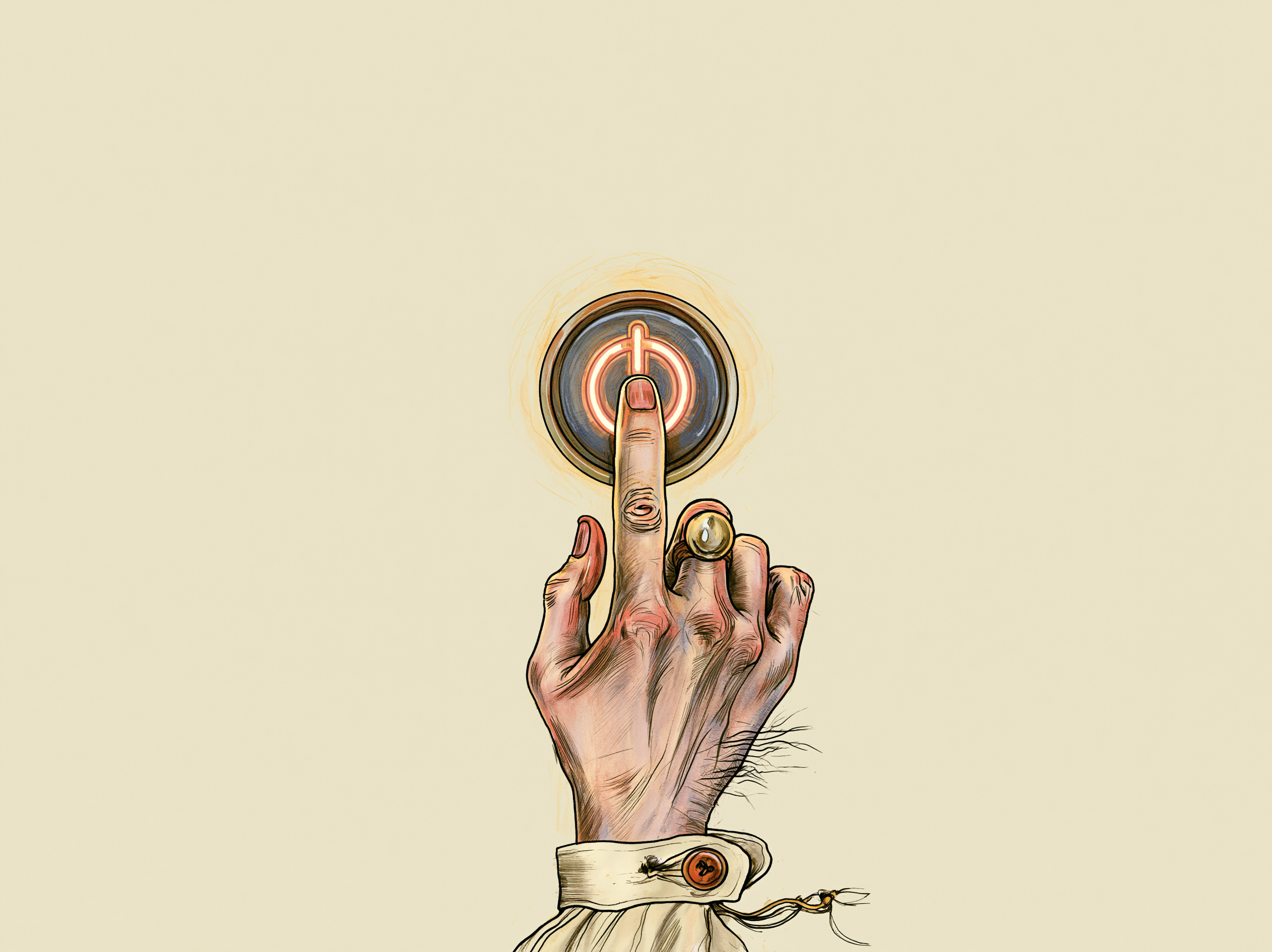
Somewhere right now there is a room you are not allowed into, full of people paid more than you will ever see, and every screen in it is red. The system they are staring at moves a national economy’s worth of money between breakfast and lunch, and it has stopped. There are people in that room with a list of certifications longer than you are tall. There are vendors on three continents awake at ungodly hours. There is a bridge call with ninety participants and a documented escalation path that runs all the way up to someone with a corner office and a driver.
And the thing that finally fixes it, after the experts and the vendors and the ninety on the call, is that somebody turns it off and turns it back on again.
Nobody says this part out loud afterwards. It does not go into the incident report in those words. But that is what happened. They rebooted it. Some of the most expensive architecture in the world, brought back to life by the same gesture you would use on a television remote that has started misbehaving, or a toddler mid-meltdown. Walk away, count to ten, try again, hope it comes back in a better mood.
It is the same act all the way down. There is no level of importance at which it stops working and no level of triviality at which we stop trying it. Below the trading floor sits the company whose entire office cannot print, and below that the video call that will not find the camera thirty seconds before it matters, and below that your home router, whose four little lights you have learned to read like tea leaves. Then the laptop that will not wake. Then the phone. Then the single earbud that has decided, for reasons it will not share, to stop being an earbud. You hold the button. You wait. You put it back in the case and take it out again, which is a reboot wearing a different coat. And somewhere in that descent, without noticing, you stopped being the person watching the experts and became one of them. You have done this. You did it this week.
Here is the part that should keep you awake, except it does not, because none of us has the energy. Nobody knows why it works. Not the helpdesk reading from a script, not the engineers who maintain the thing, not the people who designed it and signed it off. Somewhere in the gap between off and on, whatever had gone wrong quietly lets go of whatever it was holding, and the machine comes back without ever telling us what the matter was. We built the most complicated systems in history out of logic and mathematics, and the maintenance manual, the real one, the one that works, is a superstition.
And then there is you, a more complicated machine than anything in that room, running on the same procedure. You call it sleep. Once a day you lie down in the dark, switch yourself off for eight hours, lose consciousness entirely, and trust that you will come back on in the morning and resume being a person. Nobody can fully explain why this is necessary or why it works. Not the doctors, who, when you are run down and frayed and not booting properly, will tell you the oldest thing in medicine: go home, lie flat, try again tomorrow. Which is to say, have you tried turning yourself off and on again. We are all held together by a repair we do not understand and cannot skip. We perform it tonight, on faith, the way we always have. Then we get up and do it again.