



The hands went up before I finished.
Not straight away. There was a gap of about four seconds between the sentence and the first one, which is roughly how long it takes to decide you disagree with someone with enough standing that disagreeing carries a cost. Then a second. Then three more, stacked in the participant list, waiting.
I was on a call with a room full of incident commanders. The subject was political incidents, by which I mean the ones where the severity arrives before the impact assessment does. What I said was this: in a political incident it is easier not to fight it. Take the escalation. Run the room like you didn’t. Pay lip service to the executive right up until the point they leave the bridge.
I have said less popular things in that forum. I have not said one that produced a quieter four seconds.
They waited. That is the part worth recording. Nobody interrupted, nobody typed in the chat, and the hands stayed up while I finished a spiel that had another two minutes in it. This is a room of people trained to hold position under pressure and let the commander finish. They applied the training to me.
Then it came back, and it was not tactics. It was principle. Push back. Hold the line. Defend the process. The severity matrix exists for a reason, and the reason is that somebody has to be willing to say no to a senior person while the phone is ringing.
What I had not expected was who it came from. Not the new ones.
They said it the way you say something about a thing being taken from you.
I thought they had it precisely wrong. I still do.
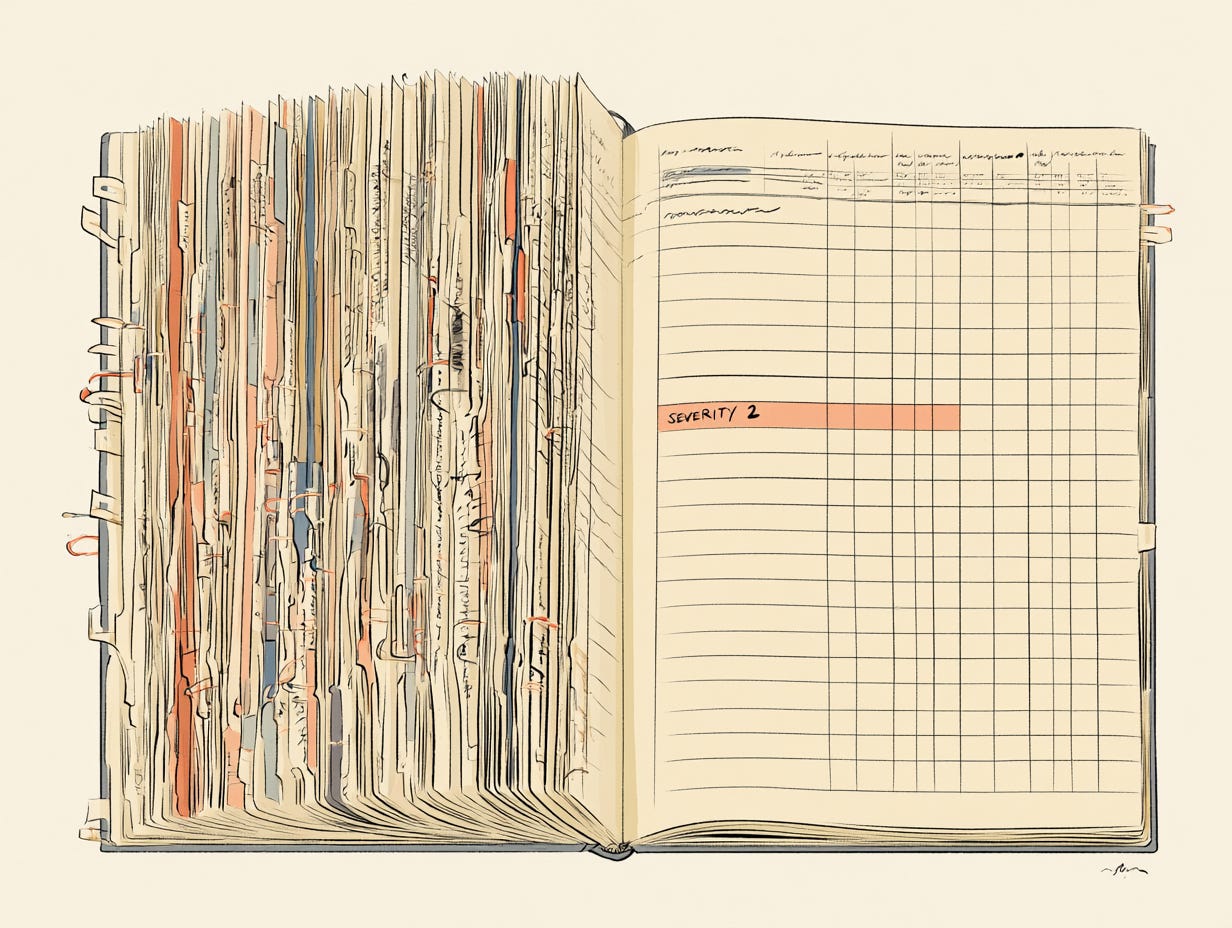
Here is what I had done before I stopped doing it.
I fought them. Every time. I had the matrix, and the matrix was clear, and I could show you the row and the column and the impact definition that put the thing at a three. This is not difficult work. Anybody can read a table. What I did not understand for a long time is that nobody I was arguing with was reading it, or had ever read it, or had at any point agreed to be bound by it.
So it goes to the manager. The manager takes it up. It comes back down a different pipe entirely and it arrives mid-incident, from a skip two levels removed, and it is four words long. Just do it, please.
You are on a bridge with fourteen people and an unhealthy service. You have spent forty minutes of the incident on the severity field. And you are going to lose the forty-first as well, because the answer was always going to be yes, and the only thing your forty minutes bought was a record of you being difficult about it.
Then the hallway. Days later, no meeting invite, no thread. Someone stops you near the kitchen and says you should just do what is asked. Friendly. Actually friendly, which is the part that stays with you. They are not delivering a reprimand, they are doing you a favour, passing on something said about you in a room you were not in.
It arrives in myriad channels, that irritation. Never the one you fought in.
I used to read this as a failure of the framework. It is not that.
They were never working to our severity matrix. They had a pressing need and an escalation of their own and a matter to deal with, and they had learned that the smaller the number the faster their matter moved. That is not a misunderstanding of the process. That is a correct reading of it.
It is the cost of running a good incident command practice. When urgency is high, people look for the fastest lever in the building. You built it.

I get paged into a bridge already in progress. This happens. What happens less often is that when I arrive there is someone three levels above me on the call, issuing instructions.
So something has occurred. I do not yet know what.
I run the intros anyway, because the ritual is load-bearing and because it buys me ninety seconds of looking at people. Commander on the call. Where are we. What is the sitrep. Who has the deployment.
The engineers answer. They answer correctly, in order, with the right level of detail. And they are sullen in a way I recognise before I can account for it. Not tired. Not stuck. There is a particular flatness that people carry after they have been told off for a decision that was right, and they know it was right, and they have worked out that saying so a second time will cost them more than the first time did.
I do not ask what happened before I joined. I have the answer.
So I smile. I take the plan from the team, and I read it back, and I confirm the deployment window and the rollback trigger. Then I turn to the person three levels up and I ask whether there is anything else.
There is not. Command is visible, the number is correct, the machine is running. They disembark.
I count four seconds.
Then I say the actual thing, which is this. The deployment takes three hours. Plan B is staged. The alerts are rigged and they will fire, and until they fire there is nothing here for any of you to do.
I ask whether we need to be on this call while it runs.
They look at me like I have taken the floor out. Twenty minutes ago they were reprimanded for running a three as a three, and now the incident commander is standing them down from three hours of watching a number increment on a dashboard nobody is going to act on.
We push what matters into the channels. We adjourn. Three and a half hours later it resolves.
The executive is satisfied. The team is intact. Nobody has had a conversation about the severity matrix, because there was nothing to have a conversation about. The severity is a two. It says so in the record.
I did not run a two. I ran a three with a two written on it, and I sent six people home.

Here is what I told the room of incident commanders, and here is where it stops being true.
I told them the loop closes. Absorb the escalation, run the incident properly, and the correction arrives later, in the review, where everybody has hindsight and nobody has adrenaline. The severity gets named as inflated. The record gets amended. It costs nothing because by then it costs nothing.
I have sat in a great many of those reviews. I have watched that correction arrive perhaps a handful of times.
What happens instead is that I read a post-incident review for a severity two and the review is not about a severity two. The impact section does not describe an impact. The timeline has a forty minute gap at the start that nobody explains. The whole document has the shape of a thing written around an object rather than about it.
So I ask why it was escalated.
Nobody answers. I ask again, differently. Somebody offers a technical reason that is not a reason. I ask a third time, and this is the part I want on the record, because three times is not a rhetorical device, it is the actual number, and by the third one everybody in the room understands that I am not going to stop.
Then someone says it. Meekly, or with a flash of irritation at having to be the one. A head of engineering escalated this. An executive did not have a report on time.
And the room changes. Not to relief. To something closer to embarrassment, the collective adjustment of a group of adults who have all been carefully not saying the same thing and have just found out that everyone else was doing it too.
Unless you were on the bridge, it is not information. It is folklore. It is passed in hallways and hushed the way you hush a name you do not want to summon, and it never once travels far enough to reach a document.
That is not a review process failing at its job. A review process that cannot write down who escalated something is telling you what it is for. It is for reviewing engineers.
The absorption works. I have never doubted the absorption. It was the other half I promised them, the half that closes the loop, that I had less evidence for than I sounded like I did.
Absorption without correction is not neutral. It is a subsidy. I gave that executive a resolved incident, a satisfied bridge, no friction and no consequence, and a review that could not write down what they had done. The next one arrives sooner. Absorb and correct, or do not absorb.
So I ask the room whether we can put it in the review.
They say yes. They mean it at the time, or they mean it enough. Sometimes it appears. More often the document goes out unchanged, and the cycle starts again some weeks later with different people and the identical shape.
Smile and nod. Agree in the room, decline in the artefact.
I know that move. I taught it in a forum once and five hands went up.
What goes in instead is the actions. There are always actions, because a review without actions is a review that failed, and everybody in the room understands the assignment. So they write them. Deliver the next phase of this project faster. Improve the reliability of the report generation. Owners against each one. Due dates. Engineering time apportioned in a planning session six weeks later by people who were not on the bridge and will never be told why the work exists.
This is administrative violence. The three hour call was not. A three hour call costs an afternoon. This costs a quarter, and it is the only account of the event that will exist in five years.
The whole thing is measurable, and the measurement is simple. Ask whether the review can record who escalated it and why. Do not argue for it. Just ask, and then watch what the answer is.
A review process with an aversion to authority will never work. The answer to that one question tells you exactly how safe the people in that building actually feel. Not the survey. Not the values on the wall. Whether a document can contain the sentence “this was escalated by a head of engineering because a report was late,” and survive.
I stood in front of a room of commanders and they told me I was giving something away. They said it the way you say a thing is being taken from you.
They were right that something was being taken. Nobody has come for the severity matrix.
What gets taken is the record. Every absorbed escalation produces a document that is accurate about the outage and silent about the cause.
And the incident is a two. The record says so. It will say so forever.